US envoy signals split with Israel over Druze region in Syria
Special envoy Tom Barrack suggested Washington prefers government control in Suwayda, diverging from Israeli support for a local militia leader.
By Katherine Barnes ·
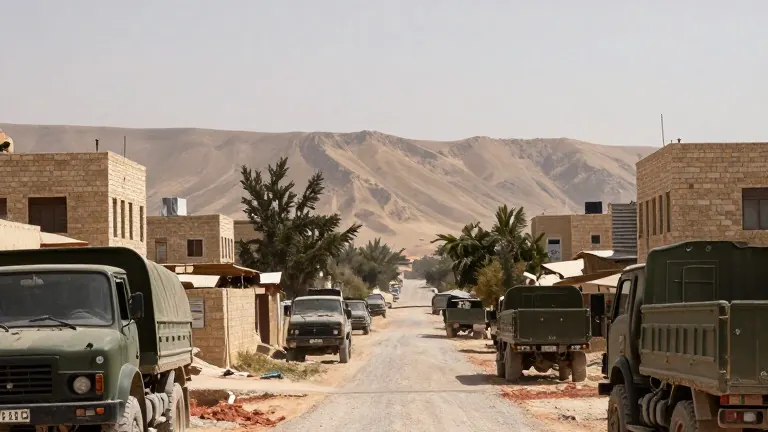
Syria's southern province of Suwayda remains a contested zone where the central government has not reasserted full authority. This stalemate persists despite diplomatic efforts to stabilize the region following the collapse of the previous regime.
US Special Envoy Tom Barrack recently indicated that Washington favors the Syrian government retaining control over the Druze-majority governorate. In an interview with Australian social media personality Mario Nawfal on Friday, Barrack referenced a specific local leader, identified by analysts as Sheikh Hikmat al-Hijri. The comments were interpreted as a signal that the United States distinguishes its position from that of Israel, which has backed al-Hijri's National Guard.
Al-Hijri leads a Druze armed group accused of receiving Israeli support and pursuing separatist goals. Barrack's remarks appear to challenge the perception that US interests align with al-Hijri's faction. Navvar Saban, a researcher at the Arab Center for Contemporary Syrian Studies, stated that the message was clear: Israel's backing of al-Hijri does not equate to American support.
The tension stems from differing strategic views on the new Syrian leadership under President Ahmed al-Sharaa. Since Bashar al-Assad fell in December 2024, the United States has moved to rebuild relations with Damascus. In contrast, Israeli Prime Minister Benjamin Netanyahu has maintained a harder line, viewing the new government with skepticism. Israel seized land in the Quneitra governorate and other strategic areas immediately after the regime change.
Israeli forces have bombed the Syrian Ministry of Defence and detained civilians in southern Syria. These actions have drawn sharp criticism from officials in Damascus. Barrack, who also serves as the US ambassador to Turkiye, is known for his direct diplomatic style. His recent comments suggest Washington is prioritizing an agreement with Damascus, even as Israel pursues its own security demands in the south.
The roots of the conflict in Suwayda trace back to 2023, when residents protested against the Assad regime. The protests continued until the regime collapsed in December 2024. While many locals celebrated the end of Baathist rule, they remained hesitant to support the new leadership. This hesitancy turned to open opposition after sectarian fighting between Bedouin tribes and Druze communities in July 2025 resulted in heavy casualties, predominantly among the Druze.
During the July 2025 clashes, forces linked to the government fought alongside Bedouin groups. Israel intervened by attacking Syrian government forces it said were entering Suwayda. Since then, Israel has sought to build relationships with local leaders like al-Hijri, who opposes the new Damascus leadership. Analyst Nanar Hawach noted that Israel appears to use Suwayda as a lever against Damascus, offering enough support to keep the province reliant on Israeli protection.
In September 2025, a trilateral agreement was signed in Amman, Jordan, involving the US, Syria, and Jordan. The accord called for an independent international commission to investigate the July 2025 events and ensure perpetrators were brought to justice. While major fighting has not resumed, distrust remains high in Suwayda. Residents feel pressure from Damascus through salary adjustments, exam changes, and access to the capital.
Saban emphasized that a durable settlement requires credible accountability for the 2025 violence. The Druze community needs guarantees of protection for movement, education, and security. Hawach added that al-Hijri's authority rises with the community's sense of threat. As long as the situation remains framed in security terms, residents seeking a path between central rule and separation are crowded out.
The US continues to engage with Damascus through talks hosted in Jordan. The goal is to resolve the crisis in Suwayda and integrate the province back into the Syrian state. Analysts agree that neither weakening al-Hijri nor restoring government institutions alone will rebuild trust. The focus now shifts to whether the international commission can deliver the accountability required to end the deadlock.
Source: Al Jazeera