Carrion crows match primate decision logic in speed tests
New research shows birds use the same mathematical framework for visual judgments as primates, despite lacking a neocortex.
By Imani Donovan ·
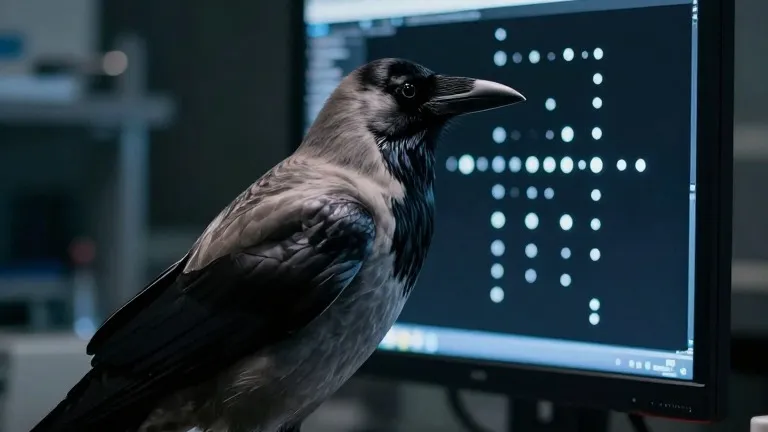
Carrion crows reach visual decisions using the same mathematical logic as primates, but they do so at twice the speed. A study published Thursday by researchers at the University of Tübingen confirms that bird brains solve complex motion tasks with comparable efficiency to human and monkey brains, even though the avian brain structure lacks a neocortex.
The team tested two hand-raised carrion crows on a random-dot-motion task. The birds sat before a touch-sensitive monitor displaying a cloud of flickering white specks on a black background. Some percentage of the dots drifted toward one of four directions. The crows indicated the direction by pecking a target next to the screen, earning a mealworm for correct answers.
This experiment mirrors decades of primate research. In monkeys, neurons in the neocortex accumulate visual evidence over time. Their firing rates increase until they cross a specific threshold, triggering a commitment to a choice. Because birds do not possess a neocortex, scientists previously questioned how their differently organized brains encoded similar decisions. Andreas Nieder, a neurobiologist at the University of Tübingen, identified this gap as the central question of the work.
"This was the big question," Nieder said. "How [would] a differently organized avian brain encode decisions?" His colleague Philipp Schmidbauer assisted in the recordings. The researchers designed the setup to be identical to the primate version to ensure valid comparison. The only physical difference was the output method. Monkeys use eye movements to report their choices, while the crows used beaks to peck the targets.
The difficulty of the task varied based on the percentage of dots moving coherently. At the easiest level, 81 percent of the specks moved together, making the direction obvious. At the hardest level, only 3 percent moved in unison, creating a signal barely distinguishable from random noise. The team also included a condition where 0 percent of dots moved, meaning there was no correct answer. The crows successfully navigated these varying conditions, demonstrating the same underlying processing strategy as primates.
The findings indicate that a brain without a neocortex can arrive at decisions through a comparable process. The crows solved the task with the same mathematical logic observed in mammals. However, their reaction times were significantly faster than those of the monkeys. The study provides concrete evidence that distinct neural architectures can converge on similar decision-making mechanisms.
Source: Ars Technica