Georgia Skywatchers Face Final Week to Spot Halley's Comet Debris
Annual Orionid meteor activity peaks this week, offering residents a brief window to see glowing trails before the shower ends in early November.
By Katherine Barnes ·
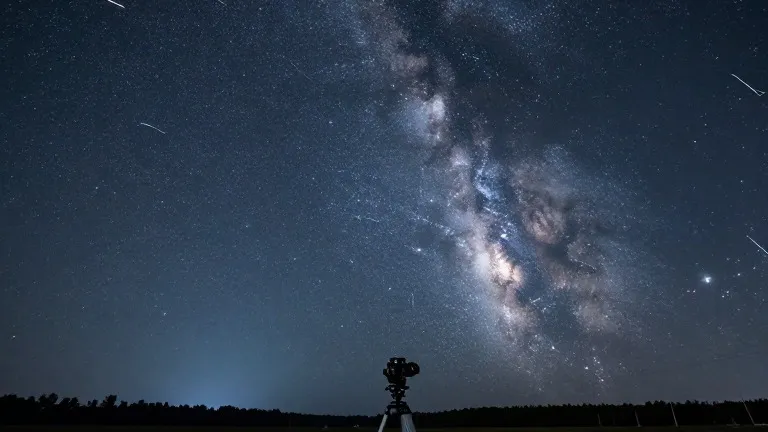
Residents of Georgia have until Nov. 7 to observe the annual Orionid meteor shower. The event allows skywatchers to view glowing trails of space debris that originated from Comet 1P/Halley. Although the comet itself is currently more than 3 billion miles from Earth, the particles it shed continue to burn up in the atmosphere.
The shower activity has been building toward its peak this week. On Oct. 21, astrophotographer Tim McCollum documented the phenomenon over Toccoa, Georgia. He recorded three distinct meteors between 3 a.m. and 4 a.m. The image captures the streaks moving away from the shower's radiant point, which is located near the red giant star Betelgeuse in the constellation Orion.
McCollum used a Canon EOS Ra camera with an RF 28-70 f2.0 lens to capture the event. He employed a star tracker to keep the equipment aimed at the radiant point. The photographer took multiple 30-second exposures and merged the frames into a single composite image using PixInsight software. The final photograph includes the Orion Nebula, the Rosette Nebula, and various star clusters within the Milky Way's galactic plane.
The Orionid shower remains active for the next several days. Observers do not need specialized equipment to see the meteors, but clear skies and dark locations improve visibility. The debris stream is associated with Halley's Comet, which last visited the inner solar system in 1986.
Earth is also passing through debris streams from Comet 2P/Encke during this period. This activity produces the Taurid meteor shower. The Taurid stream can occasionally generate large, bright objects known as Halloween Fireballs. These rare events may appear alongside the standard Orionid meteors in the coming nights.
Space.com has invited photographers to share their own images of the shower. Interested individuals can send their photos, comments, names, and locations to spacephotos@space.com. The opportunity to capture these specific trails ends on Nov. 7, when the Orionid activity concludes.
Source: Space.com