Satellite Data Confirms 9,000 Hectares of New Poppy Fields in Balochistan
Afghan farmers are leasing land in Pakistan and Iran, shifting opium production away from Kabul following the Taliban's 2022 narcotics ban.
By Katherine Barnes ·
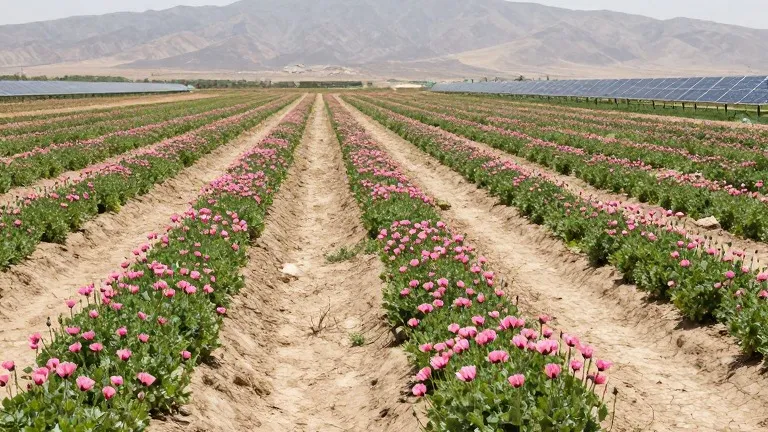
Satellite imagery identifies more than 9,000 hectares of poppy cultivation in Pakistan's Balochistan province, marking a sharp increase in regional opium production. The data comes from Alcis, a British firm that analyzed images alongside interviews with local growers. David Mansfield, a UK-based expert on Afghanistan's illicit drugs trade who authored an August report for the firm, cited the findings. He noted that the Taliban's 2022 ban on narcotics has not eliminated cultivation but has displaced it across the border.
Mansfield stated that the remote borderlands shared by Pakistan, Iran, and Afghanistan have become a global center for opium production. The shift is driven by Afghan farmers from provinces like Kandahar and Helmand who are crossing into Pakistan to lease land. These growers bring capital and expertise, often investing millions of Pakistani rupees in solar-powered wells. They share profits with local landowners, creating a new economic model in Pakistan's largest and poorest province.
In Balochistan, cultivation is concentrated in the districts of Loralai and Killa Abdullah. Abdul Qahar Wadan, a former member of Pakistan's National Assembly from Killa Abdullah, described the farming as rampant. He alleged that senior military officials and pro-government power brokers back the operation by taking commissions from growers. Monawar Hussain, the district's chief administrative officer, disputed this claim. He said cultivation declined following an eradication campaign last year, though 2026 satellite imagery shows no clear evidence of such removals.
Local residents point to economic pressures that favor opium over traditional crops. Lala Jan Kakar, a resident of Killa Abdullah, said insecurity, drought, and flash floods have devastated fruit farming. He observed that the demand for poppies and the resulting income far exceed those from fruit. A farmer in the same district, who requested anonymity, claimed growers pay bribes to local authorities through intermediaries. He noted that when media pressure mounts, growers sometimes plant on barren land so officials can destroy the crop and publicize the effort.
A similar pattern has emerged in Iran, where Afghan farmers work as tenants and sharecroppers. Cultivation is reported in provinces including Razavi Khorasan, Kermanshah, Lorestan, and Fars, but Sistan-Baluchistan remains the primary producing region. Satellite images from 2026 show extensive fields in that province, some equipped with drip irrigation. Mansfield described this as a shift from mixed farming to large-scale poppy monoculture, noting that the costly infrastructure suggests growers expected little risk of eradication.
Inside Afghanistan, production is rebounding despite the ban. Output is concentrated in northeastern Badakhshan Province, which accounts for roughly half of national production, and several southwestern provinces. Mansfield reported that southwestern cultivation almost doubled between 2025 and 2026. Farmers in these areas are defying the ban, often hiding crops within wheat fields or behind compound walls. The Taliban recently issued a directive barring home searches for opium without a court order, a move experts view as a concession to avoid unrest during the ongoing economic crisis.
Source: RFE/RL