Eisenkot's Yashar Party Targets Netanyahu's 19-Year Streak with Term Limit Push
Voters choose from 120 seats in a contest defined by the Prime Minister's 19-year tenure and a divided opposition bloc.
By Emma Mehta ·
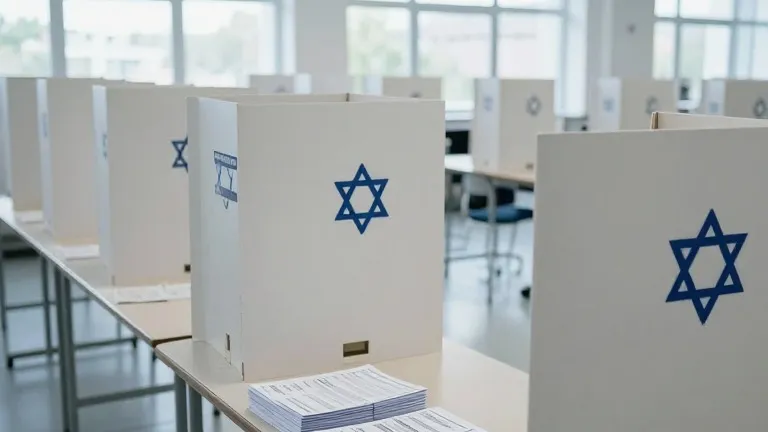
Benjamin Netanyahu faces a decisive vote on Tuesday as Israelis cast ballots for all 120 seats in the Knesset. Polls indicate a tight race between pro-Netanyahu and anti-Netanyahu camps, with the outcome potentially hinging on a single seat. The election marks a referendum on the Prime Minister, who has held power for 19 of the past 30 years, rather than a traditional left-right divide.
Gadi Eisenkot leads the opposition challenge. A former Israel Defense Forces chief of staff and son of Moroccan immigrants, Eisenkot entered politics four years ago with his party Yashar, which translates to straight or direct. He proposes US-style term limits for the Prime Minister, arguing that power corrupts. At a rally in Modi'in, supporters praised his plain style. Noa Sadeh, 56, stated she wants a leader who focuses on doing rather than talking.
The opposition bloc includes former Prime Minister Naftali Bennett and Avigdor Lieberman, both right-wing figures who previously collaborated with Netanyahu before parting ways. On the far right, Yishai Fleisher of Itamar Ben-Gvir's Otzma Yehudit party argued in Bet Shemesh that Netanyahu must be pulled right. He advocated for more settlements in the West Bank and Gaza, a ministry for voluntary Palestinian departure, the death penalty, and increased weapons for Jewish civilians.
Netanyahu has framed the election through his campaign posters, which present a rhyming choice between the right and Palestine. The posters place opposition leaders alongside representatives of parties representing Palestinian citizens, who comprise about a fifth of the population. Pro-Netanyahu media, including Channel 14, have kept opponents on the defensive. This week, Channel 14 presenter Yinon Magal called Eisenkot a Moroccan monkey, a slur Eisenkot did not repeat at his rally.
Observers note the puzzling strength of Netanyahu's support despite major setbacks. The October 7, 2023 attacks occurred on his watch. The subsequent war in Gaza killed more than 70,000 Palestinians, with Israel stating a third were Hamas combatants. Hamas was not eradicated, and Iran's nuclear threat remains. Netanyahu also faces legal issues from the Qatargate affair and an ongoing corruption trial, alongside the fallout from his court reforms.
Netanyahu's base remains loyal despite reports of credible warnings about the October 7 attacks that he failed to act upon. His allies claim military and intelligence chiefs kept him in the dark, a claim they admit is unfounded. Many expect him to outmaneuver rivals in post-election coalition talks. His durability rests on three decades of building this loyal support network.
Opposition hopes include energy from abroad, with liberal and secular expatriate Israelis flying home to vote. This group is not captured in standard polls and could decide the result if it turns on one seat. On Thursday, a state ceremony marked the 1995 assassination of Yitzhak Rabin. Netanyahu stayed away and sent a low-ranking minister. Yair Golan, leader of the Democrats and a former general, expressed optimism that opposition leaders can agree on a long-term regional security strategy.
The word peace remains sensitive for many Israelis but has not disappeared. A widely shared video showed young Israelis at a Negev music festival singing Shir LaShalom, the song Rabin sang before his death 31 years ago. For some, this display and the full flights home suggest the age of Netanyahu may be nearing its end.
Source: The Guardian