El-Sayed Faces Rogers in High-Profile Michigan Senate Battle
With polls showing a narrow lead and $300 million spent, the contest centers on healthcare, foreign policy, and El-Sayed's historic candidacy.
By Katherine Barnes ·
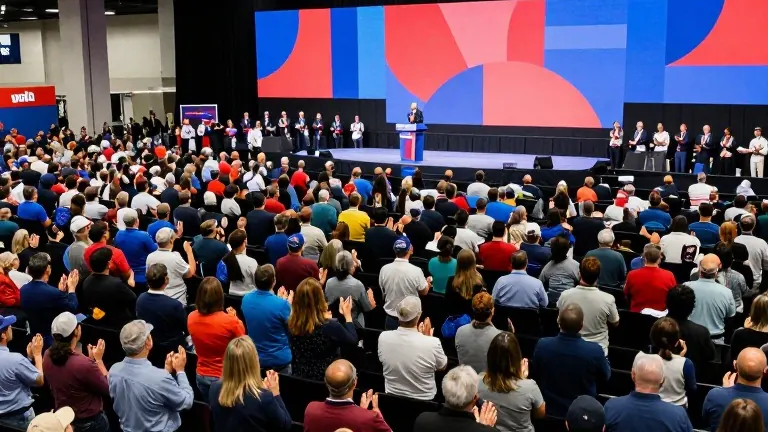
Voters in Michigan face a choice between two distinct visions for the state’s Senate seat on Tuesday, November 3. The race has drawn intense scrutiny from national and international observers who view the outcome as a bellwether for the Democratic Party’s future. Abdul El-Sayed, a 42-year-old public health advocate, challenges Mike Rogers, a 63-year-old former congressman, in a contest that has consumed nearly $300 million in spending.
El-Sayed, who previously led health departments in Detroit and Wayne County, would become the first Muslim U.S. senator if elected. He advocates for Medicare for All and has sharply criticized Israel’s conduct in Gaza. Rogers, a close ally of President Donald Trump, supports tax cuts and domestic energy production. He has pledged unconditional support for Israel while simultaneously calling for an end to the conflict with Iran, a position that allows him to distance himself from the unpopular president.
The campaign has been defined by heavy spending from outside groups. Pro-Israel organizations, including AIPAC, have poured millions into supporting Rogers. United Democracy Project, the election arm of AIPAC, has spent hundreds of thousands of dollars on mailers against El-Sayed and funneled $9 million to a Republican group supporting Rogers. On the Democratic side, the Senate Majority PAC and its affiliate WINSENATE have been the largest spenders, backed by businessmen Eychaner Fred and Amos Hostetter Jr. Republican spending has been driven by the Senate Leadership Fund, MAGA Inc, and No Going Back, groups funded by donors including Miriam Adelson and Elon Musk.
The presence of Haley Stevens, the Democratic House representative who lost the primary to El-Sayed, has added a layer of internal party tension. Stevens endorsed Rogers days before the election, citing El-Sayed’s stance on Gaza. She stated that while she would still vote for the Democrat, the party must focus on winning the seat. El-Sayed responded in a statement, noting that defeating Trump’s hand-picked candidate should be the priority, yet Stevens seems intent on relitigating a primary that ended three months ago.
For many in Arab and Muslim communities, the race carries personal weight. Chadi Abdulrazek, an Arab American activist and small business owner, told Al Jazeera that supporters are speaking to journalists from Denmark, Sweden, the Netherlands, France, and the United Kingdom. He described the election as a chance to hold Trump accountable for broken promises and to stand up against Islamophobic attacks. Former state legislator Cynthia Johnson said the negative campaigning around El-Sayed’s religion makes the stakes life or death for her community.
Polls currently show El-Sayed with a narrow lead of four to seven percentage points. However, the Cook Political Report classifies the race as a toss-up, noting that Michigan polls have often been unreliable in recent decades. Both campaigns have warned that the result could hinge on a few thousand votes. Early voting is underway, with hundreds of thousands of ballots already cast. Polls close at 8 p.m. on Election Day.
If the race remains tight, Michigan may not know the winner until Wednesday morning. In the August primary, the Associated Press did not call the race until 10 a.m. the following day. A similar timeline is possible this time around, though a commanding lead for either candidate could produce a projection hours after polls close.
Source: Al Jazeera