NHTSA Drafts Rule Giving Driverless Cars a Unique Cyan Identity
The agency seeks to standardize visual signals for autonomous vehicles while removing obsolete requirements for manual controls.
By Imani Donovan ·
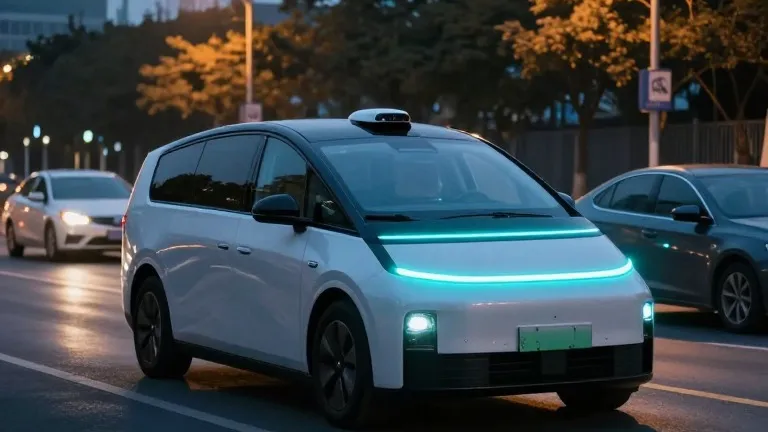
Drivers in cities with robotaxis will soon have a distinct visual cue to identify vehicles without human operators. The National Highway Traffic Safety Administration has proposed a mandatory color standard for these cars: a specific blue-green shade known as cyan. This single marker would signal to pedestrians, cyclists, and police that an automated system is in control of the vehicle.
The proposal amends Federal Motor Vehicle Safety Standard No. 108, which currently governs all vehicle lighting. NHTSA officials argue that the current palette of red, amber, white, and flashing blue or red lights is already crowded with specific meanings for braking, signaling, and emergency use. Cyan fills a visual gap, allowing a driverless car to be instantly recognizable without confusing other road users.
Under the draft rule, installing cyan marker lamps remains optional for manufacturers. However, once a company chooses to use them, the lights must meet federal requirements for color, brightness, and placement. This approach aims to replace a potential patchwork of proprietary signals with a uniform national standard. The agency envisions adoption by major players including Waymo, Nuro, Zoox, GM, and Mercedes-Benz.
The rewrite also simplifies regulations for vehicles designed without human drivers. NHTSA proposes eliminating requirements for physical hazard switches, manual beam shifters, and turn levers, which serve no purpose in a fully automated cabin. The agency is also updating the 12.8-volt testing standard to accommodate modern LED systems and is considering relaxing rules on the vertical placement of high-beam lights relative to low beams.
These changes align with a broader Department of Transportation strategy to accelerate the deployment of autonomous technology. The goal is to ease the path for automakers building cars that lack traditional controls like steering wheels and pedals. While state-level approvals for similar signals already exist, such as Mercedes-Benz’s earlier use of turquoise lights on its Drive Pilot system, NHTSA seeks a unified federal framework.
The new standard does not immediately change how current models are built. NHTSA is still enforcing existing rules, as demonstrated last month when the agency opened an audit query into the Tesla Cybercab. The investigation examines the technical data Tesla used to certify the vehicle, specifically regarding the absence of sideview mirrors, pedals, and a steering wheel required by current federal standards.
Source: The Verge