New Maps Failed to Deliver GOP Midterm Edge in Key States
Redistricting efforts in seven states aimed at securing Republican seats were largely nullified by a broad Democratic surge in the 2026 midterm elections.
By Emma Mehta ·
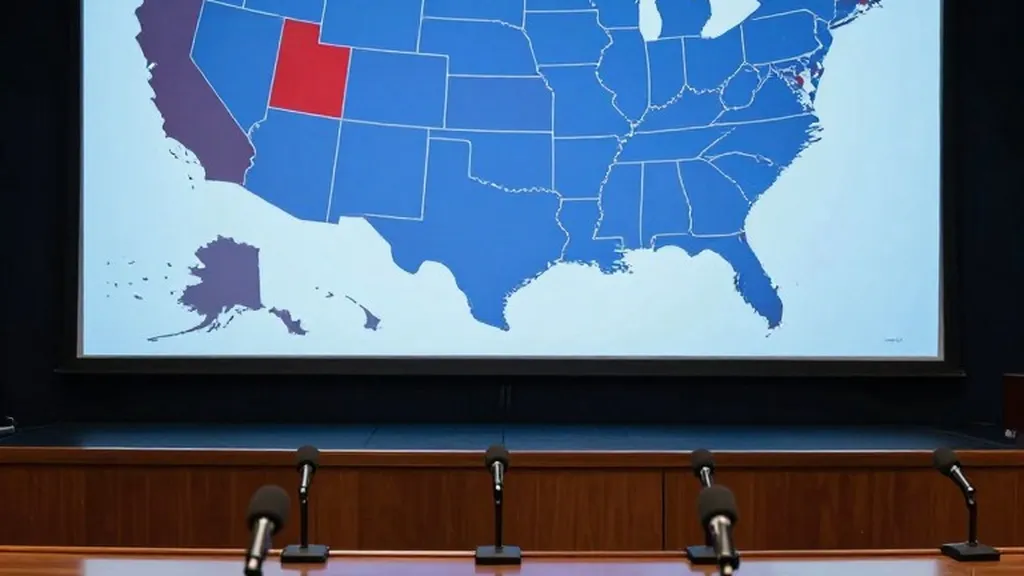
At the urging of President Donald Trump, Republicans in eight states redrew the boundaries of dozens of congressional districts over the past year while angling for an edge that could help them hold onto a slim House majority in a tough midterm election. The strategy sought to capitalize on population shifts and legal victories to flip specific seats in favor of the Republican Party. However, the final results from Tuesday indicate that the new maps did not provide the intended advantage.
According to the Associated Press, the Republican redistricting plan fell flat in Alabama, Florida, and Texas. In Missouri, the plan was scuttled by courts before the election and then firmly defeated by voters on Tuesday. In California, a retaliatory Democratic redistricting effort flipped previously Republican-held seats, offsetting some of the gains Republicans had hoped for in other regions.
Former Attorney General Eric Holder, chair of the National Democratic Redistricting Committee, stated in an election night statement that the Trump redistricting plan was systematically dismantled. He noted that given the opportunity, voters instead chose to elect a new Democratic majority. This outcome contrasts with the pre-election expectations that the redrawn lines would create a buffer for the GOP in a competitive environment.
In Texas, Republicans reconfigured three heavily Latino districts in the Rio Grande Valley to try to boost their chances of unseating Democratic Representatives Henry Cuellar and Vicente Gonzalez. Both incumbents won reelection Tuesday. Democrats instead unseated Republican Representative Monica De La Cruz, whose district is sandwiched between theirs. Her new district retained the same percentage of Trump-inclined voters as the 2024 version, but about three in five voting-age residents were new, making it harder for her to compete against Democratic challenger Bobby Pulido.
Mark Jones, a political science professor at Rice University in Houston, said Republicans had unrealistic assumptions about a shift in Latino voting remaining in their favor. The AP Voter Poll indicates a substantial shift in Hispanics moving away from Republicans compared with Trump's victory two years ago. Nationally, about one-third of Hispanics say they backed the Republican in their local U.S. House race, while roughly four in 10 voted for Trump two years ago.
In Florida, Republicans tried to tilt four more House seats to the GOP in Trump's adopted home state. Democratic Representative Jared Moskowitz was among their targets, but he decided to run anyway in one of the redrawn districts and won reelection Tuesday. Moskowitz said he worked across the aisle and delivered results for his community, noting that opponents spent $26 million trying to beat him. He added that voters in his new district were most concerned about the economy and their ability to afford a good quality of life.
Democratic Representative Kathy Castor also won reelection in a district where about two-thirds of voting-age residents were new after redistricting. Democrat Pia Dandiya won yet another district, an open seat in southern Florida, that Republicans had reshaped for an advantage. In Alabama, a Supreme Court ruling allowed the Republican-led Legislature to revert to what the GOP considered to be a friendlier map, but Democratic Representative Shomari Figures won reelection anyway, defying Republicans' plans.
North Carolina saw redistricting lead to costly and close races. Republicans redrew two congressional districts in eastern North Carolina with a goal of unseating Democratic Representative Don Davis in the 1st Congressional District. They made Davis' district a bit more Republican by bringing in thousands of voters from the 3rd Congressional District, held by Republican Representative Greg Murphy. In exchange, they reassigned thousands of Democratic-leaning areas to Murphy's district. The ensuing advertising battle for Davis' seat cost well over $50 million, according to the ad-tracking firm AdImpact, ranking among the most expensive House races nationally.
Justin Levitt, a professor at the Loyola Law School in Los Angeles who runs the All About Redistricting website, noted that in all but one of the revamped districts, Trump would have carried over 54% of the vote had they been in place for the 2024 election. He described such districts as relatively safe in normal times but warned that it is foolish to presume that the electorate in one year is going to look like the electorate in another in a time of radical swings in public opinion. Levitt suggested that some line-drawers got cocky.
The AP Voter Poll found that about six in 10 voters disapprove of how Trump is handling the presidency, which undercut the presumed support for the new Republican districts. Republicans hoped their redistricting could net as many as four more seats in Florida, two in Ohio, and one each in Alabama, Louisiana, North Carolina, and Tennessee. The cascade of redistricting was spurred along in the South by a Supreme Court ruling that weakened federal Voting Rights Act protections for majority Black districts.
Ballotpedia data confirms that six states, California, Florida, Missouri, North Carolina, Tennessee, and Texas, used different congressional maps for the 2026 election than they did in 2024 because they voluntarily underwent mid-decade redistricting. Ohio also used a different map due to state law. As of 1:14 PM ET on November 4, Democrats had won 228 and Republicans 138 of the 435 U.S. House races, with 69 races remaining uncalled. The net change in the House is projected to be a Democratic gain of 27 seats, marking a significant shift from the previous map's expectations.
Vice President JD Vance blamed the war in Iran for the Republican midterm losses, a sentiment shared by many voters who cited the conflict as a key driver of their decision. About six in 10 voters said the U.S. made the wrong decision in taking military action against Iran, according to The AP Voter Poll. Most of those voters dissatisfied with the Iran war backed the Democratic candidate in their U.S. House race. The failure of the redistricting strategy highlights how shifting voter priorities can override structural advantages created by new district boundaries.